Hi! It's Mary again. :)
So I am taking Classical Japanese class this semester (古典), and currently I am starting a project translating passages from Tosa Nikki into English. It's really interesting to see the differences between the Japanese of the early 10th century and modern Japanese, but I find the similarities more interesting. Of course many things have changed since that time, but once you learn the grammatical rules, it is not too difficult to understand. For comparison, I thought today we could look at the English language that was being spoken around the same time.
 |
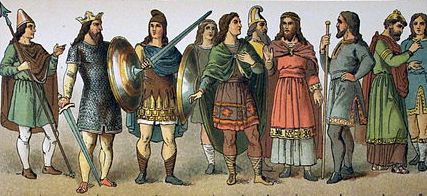
| Anglo-Saxons |
Old English was spoken in what we now call England from the mid 5th century to the mid 11th century, and is considered a completely different language from what we speak today. The reason it's considered to start in the 5th century is because that was when the Roman Empire fell and the Roman Latin speakers left England, and Germanic tribes (the Angles, the Saxons, and the Jutes) moved in and established their seven kingdoms. The language they brought isn't any different than what those peoples were speaking back in Germany, however historically speaking, the moment they moved to England, the language became considered to be English. But as this implies, English is related not to Latin, but actually to German, Dutch, Norwegian, and other Germanic languages. In fact, Old English's closest living relative is Icelandic :). Like other Germanic languages, Old English inflected case (主格、対格、与格、属格、と具格を活用する), and all nouns had one of three grammatical genders. For example, seo sunne (the sun) is femini
ne, se mona (the moon) is masculine, and þat wif (the wife) is neutral. If this is all confusing, guess what- there is a wikipedia page for it in Japanese here :D
Old English consisted of many sounds that don't exist in English today, as well as a different grammatical structure. It's clear to see how different it is when looking at something like the Lord's Prayer (from Wikipedia)

With the introduction of Christianity to England, Latin words began leaking into the lexicon. Old English is considered to end exactly in the year 1066. Do you know why? This is the year that William the Conqueror, the French Duke of Normandy, conquered England, making French the official language of the land. Of course most common people still spoke English, but over 10,000 French words entered the English language, which is why English and French still have much vocabulary in common today. The language spoken at this time is considered to be Middle English, which ended in the 15th century. Early Modern English came after the 100 years war ended with the victory of the English people, and 1650 is considered to be the start of Modern English. This is probably really boring to most of you, but I love historical linguistics, so I could talk about this stuff all day! XD Anyway, I think I'll end with this video. You can't really appreciate the difference between Old English and Modern English until you actually hear it. And it's really short, so please watch it. I hope you enjoy it! And if you have any questions, please feel free to ask me ;)


ゲビーさん、歴史言語学は面白いですね。日本の沖縄など、辺境(へんきょう peripheral)の地域の方言は、昔の日本語に近いそうですよ。 $5, $15 total 川口
ReplyDeletewow, this is really interesting topic!!! Old English and Modern English are more different than I expected! I read some works of Edmund Spenser and William Shakespeare before. Even English in that age is a little difficult for me. (it is Early Modern English which they used? ) Do you have a class of Old English when you are an elementary school student or a secondary school student, like we have a classical Japanese class?
ReplyDeleteI also study French, so I often think they are really similar. Some of my friends who are really good at English somehow understand French without studying. I am jealous of them :p hahaha
I'm glad you thought it was interesting ^_^
DeleteYeah, Shakespeare is considered the start of Early Modern English. In high school, many students are made to read Shakespeare, and we probably understand barely more than you do. XD Did you know Shakespeare is credited with adding around 2000 words to the English language? Including some very common ones, like "eyeball", "crocodile", "eventful", "fashionable", and "lonely".
NO ONE learns Old English. Even top universities like Harvard, Yale, and Princeton each only offer ONE class about Old English (I looked it up :P). Most people don't even have the smallest idea of anything about it. I am just really nerdy so I am interested in things like that :) There isn't much of a need to study it since there are very few works written in Old English, and unless you are interested in historical linguistics, learning the language would not help you understand Modern English any better.
Haha, yeah, I studied French in high school, and found a lot of similar words to English. Like to say "I am hungry" you say "J'ai faim", which is like the English word "famished"- meaning very hungry. XD So maybe you should study obscure English words to help you learn normal French ones XD Or vice vera :P